
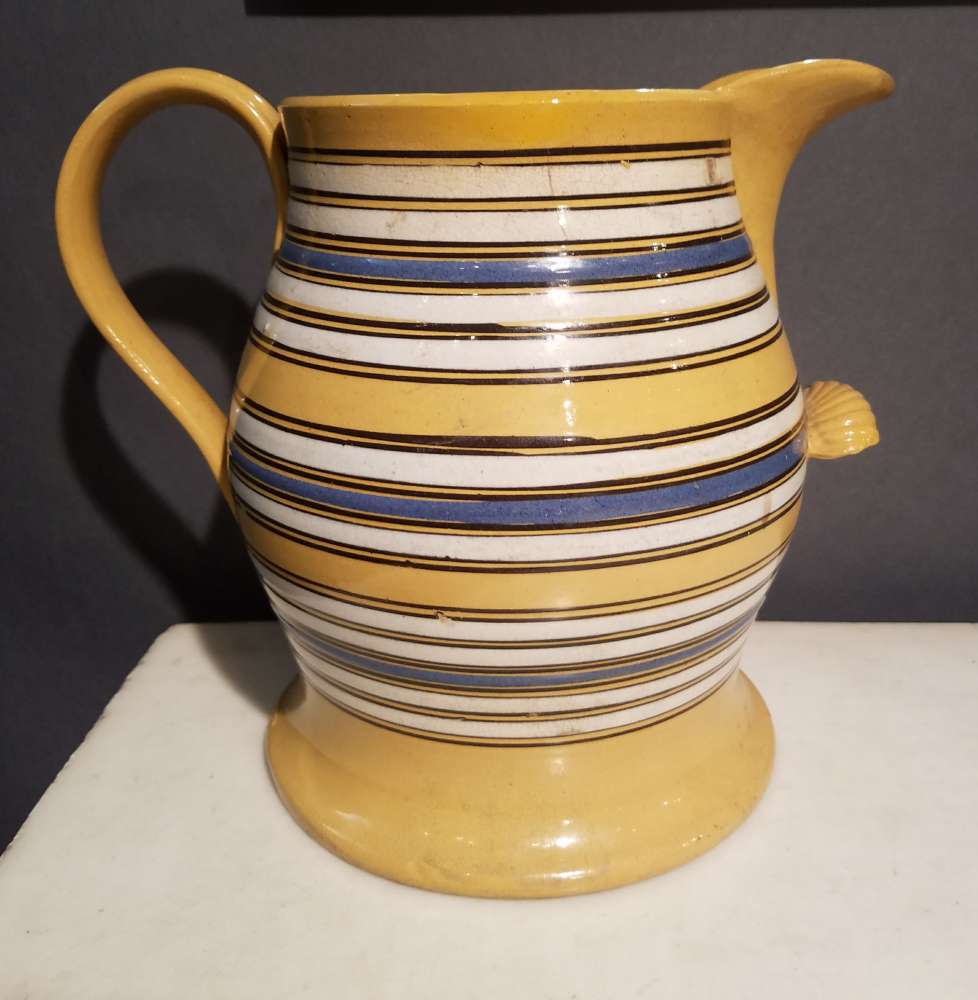
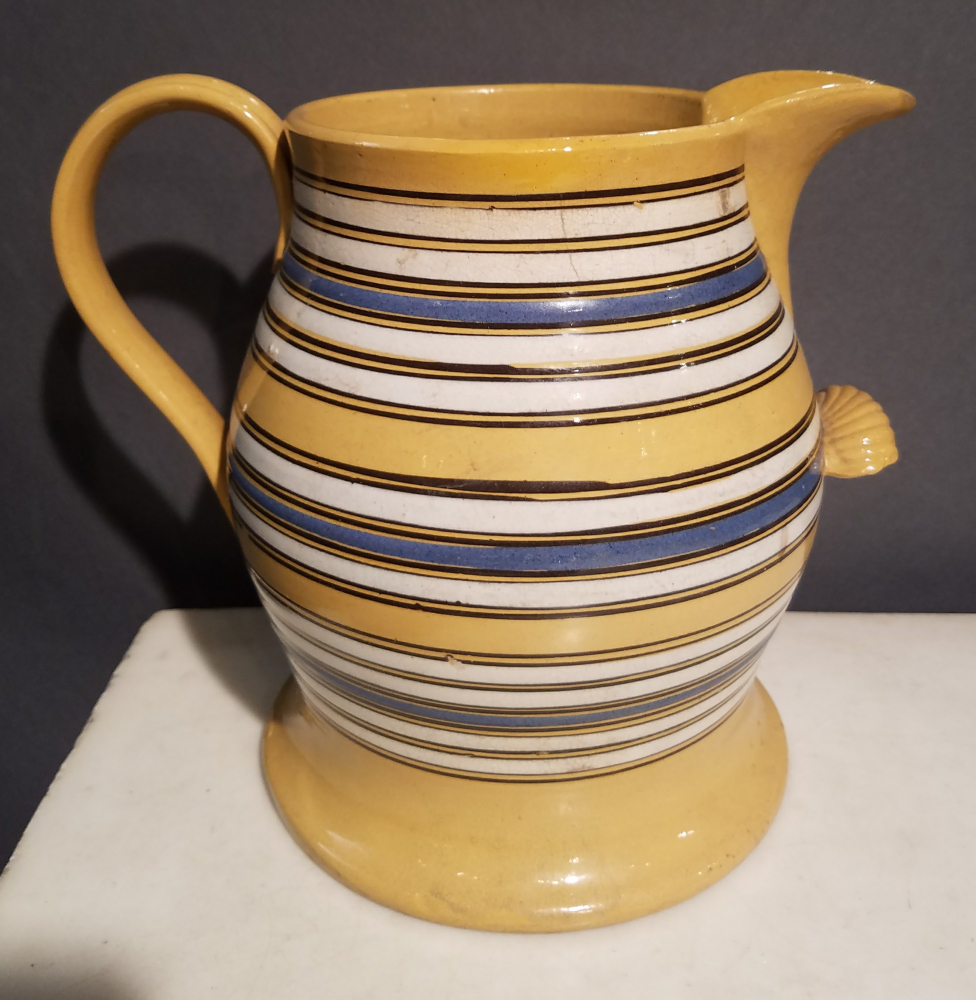
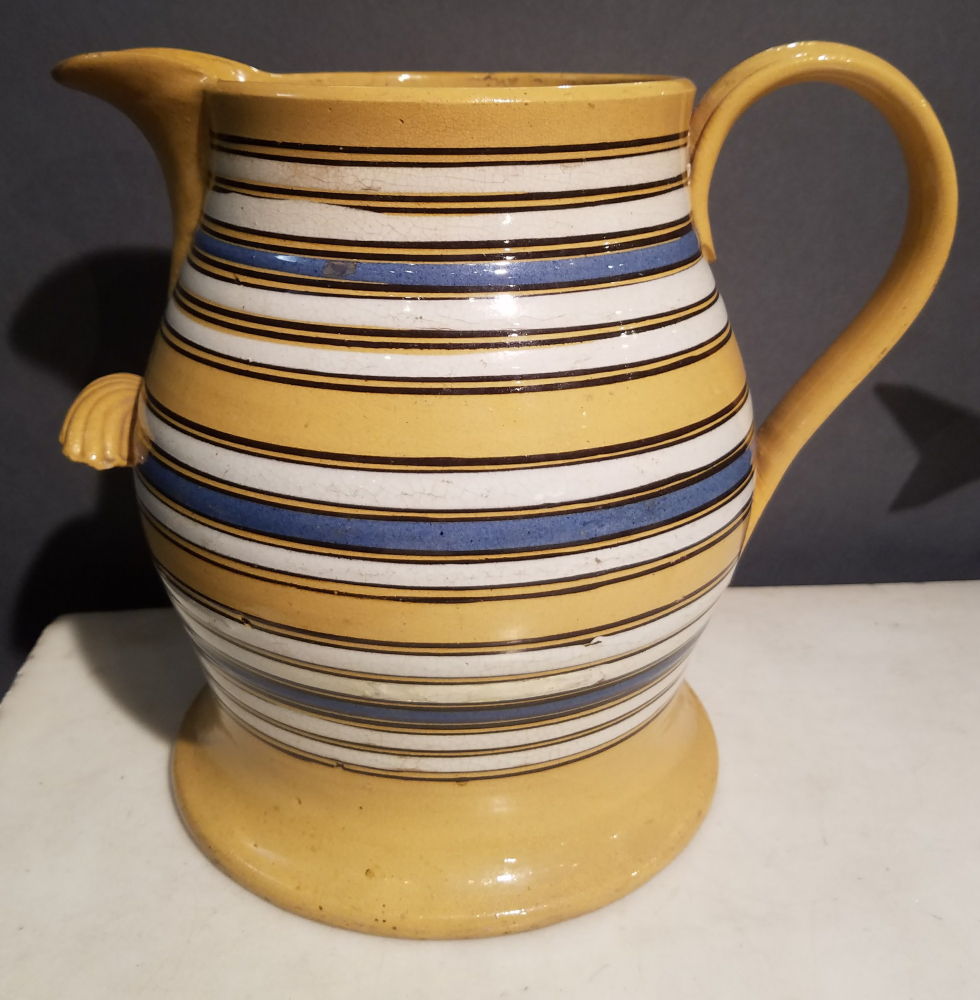
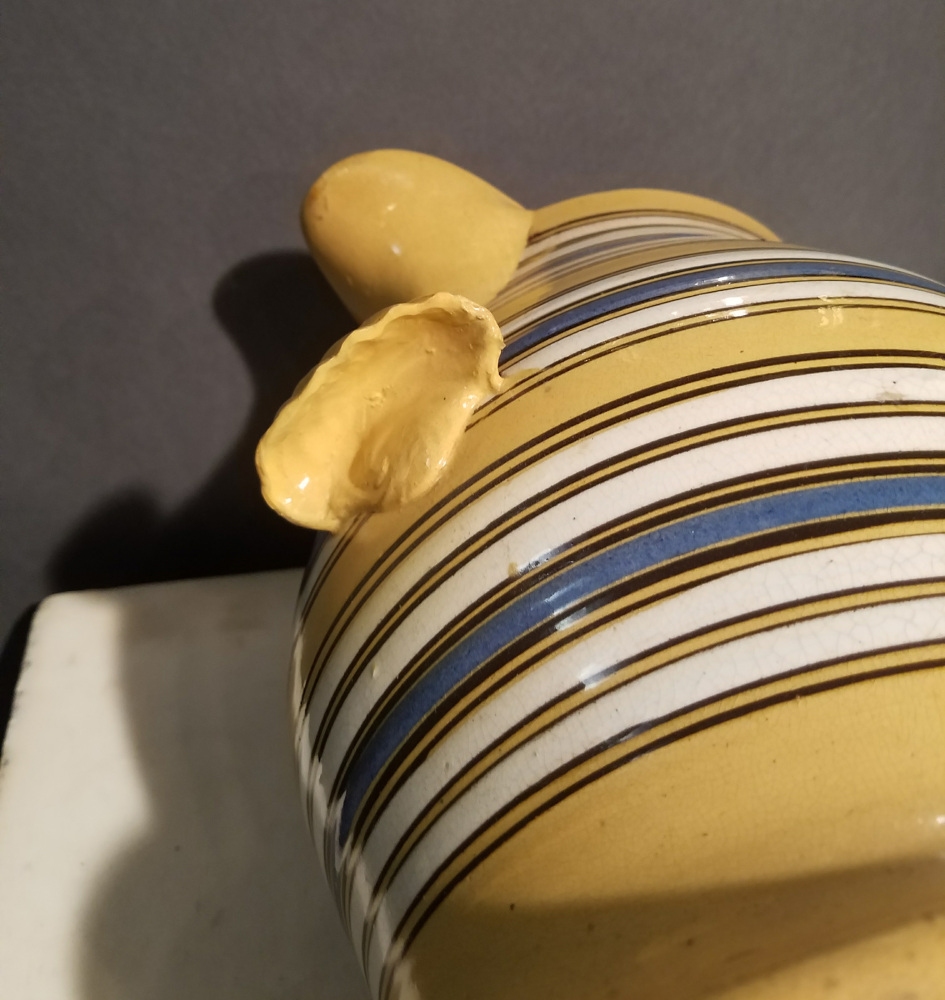
Large Mocha Yellow Ware Jug with Blue, White and Brown Slip Bands and Shell Grip Circa 1830–1840


Large Mocha Yellow Ware Jug with Blue, White and Brown Slip Bands and Shell Grip

Circa 1830–1840

Staffordshire, England


This large and boldly striped jug is a strong example of the brightly colored dipped ware produced in the English potteries in the first half of the nineteenth century. Thrown from a buff, cane-colored earthenware body that reads a warm yellow beneath its clear lead glaze, it is decorated overall with lathe-applied slip bands: broad grounds of white slip alternate with bands of the yellow body, each defined by fine lines of dark brown slip, and the rhythmic sequence is anchored by three wider bands of cobalt blue at the shoulder, at the widest point of the body, and immediately above the foot.


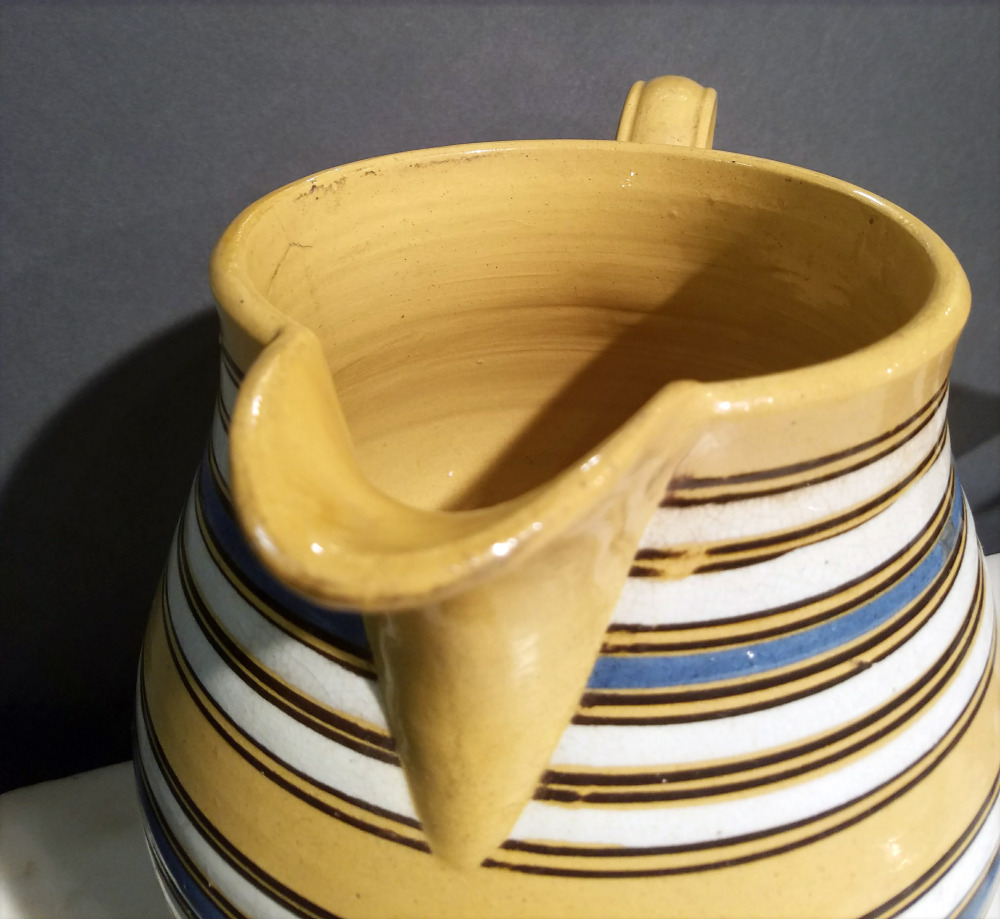
The generous ovoid body rises from a wide, flaring pedestal foot to a prominent applied spout, its lower edge tapering to a point down the body, and a high loop handle rises above the rim to a small rounded thumb rest. The distinguishing feature of the piece is the applied shell-form grip set beneath the spout, molded separately and luted to the body. A jug of this size and weight needed a second hand to steady and tip it when full, and the shell gave the fingers a firm hold while supplying a decorative flourish on a vessel of otherwise utilitarian type. The interior is glazed and retains the throwing rings clearly, and the recessed base is likewise glazed.


Dimensions

Height: 10 3/4 inches (27.3 cm)

Width: 12 inches (30.5 cm)

Depth: 8 1/2 inches (21.6 cm)


Marks

Unmarked, as is usual for dipped wares of this type.


Provenance

Earle D. Vandekar of Knightsbridge.


Condition

Good antique condition, with overall crazing to the glaze, light staining and scattered dark specks in the glaze consistent with age and use, together with minor wear to the foot rim. The shell-form grip on the front of the jug has an old repair where it was reattached to the body.


References

Jonathan Rickard, Mocha and Related Dipped Wares, 1770–1939 (University Press of New England in association with the Historic Eastfield Foundation, 2006), for yellow-bodied and slip-banded dipped wares generally.

Lynne Sussman, Mocha, Banded, Cat’s Eye, and Other Factory-Made Slipware, Studies in Northeast Historical Archaeology No. 1 (Boston, 1997).

N. Teulon-Porter, The N. Teulon-Porter Collection of Mocha Pottery (City of Stoke-on-Trent Museum and Art Gallery, 1953).


Historical Context

Dipped wares were among the least expensive decorated pottery of their day, turned on a lathe and banded with colored slips while the vessel revolved. The name “mocha” properly belongs to the dendritic decoration resembling moss agate, the “mocha stone” traded through the Yemeni port of al-Mukha, but in trade usage it has long covered the whole family of slip-banded wares, of which the simple multi-banded pattern seen here was the most common and the most affordable.

Most English dipped ware was made on white creamware and pearlware bodies. The yellow-bodied version, much favored in the American market, was produced in England chiefly from the second quarter of the nineteenth century and was taken up by American potteries at East Liverpool, Ohio, and in New Jersey and Maryland from the 1840s. Jugs of this kind were made in quantity for the domestic and export markets and served beer, cider and milk in homes, inns and taverns on both sides of the Atlantic.


NY8545-iamr


Dealer Earle D. Vandekar of Knightsbridge, Inc.
Date:
Origin
Artist/Maker
Measurements 10 3/4 inches high x 12 inches wide x 8 1/2 inches deep
Inventory View Dealer's Inventory
Website http://vandekar.com
Price 2750
Contact Paul Vandekar, 212-308-2022 or  info@vandekar.com

Stay up to date with our ADA newsletter.
