
|
 |
 |
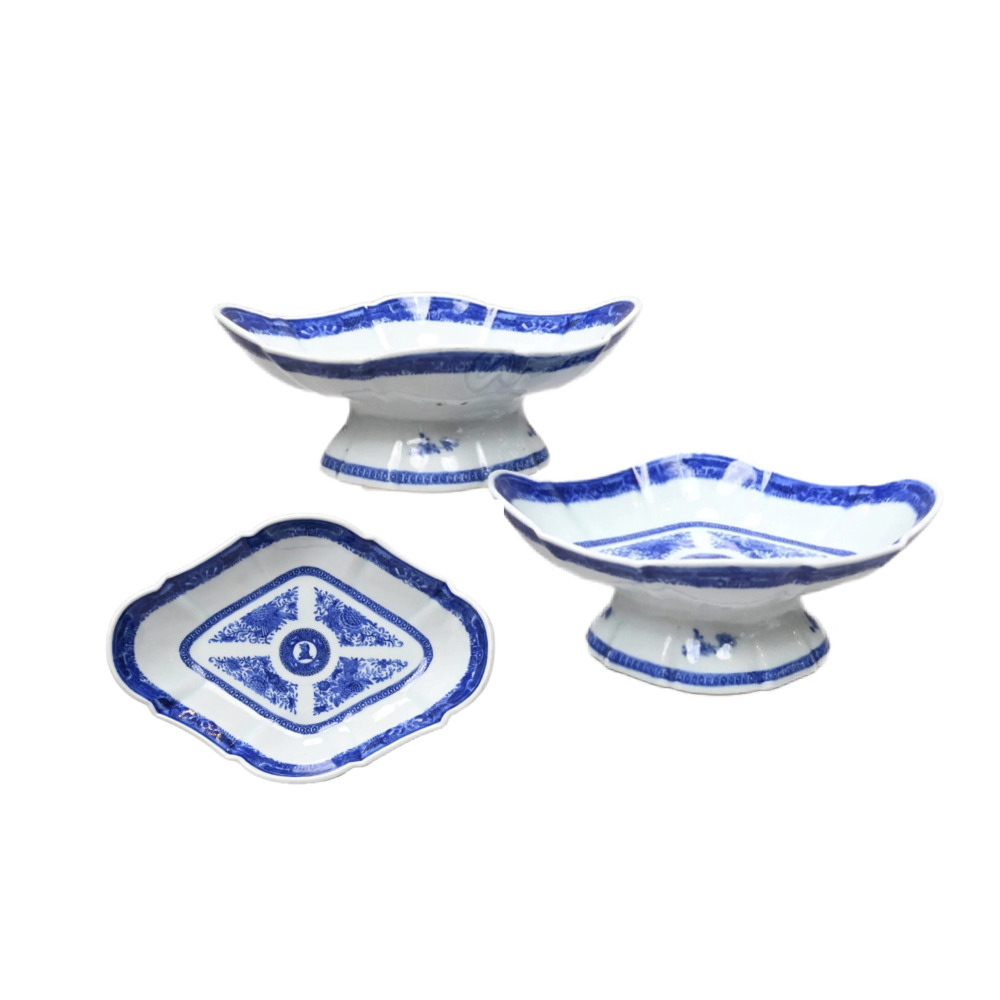
Armorial Elegance: Pair of Chinese Export Blue Fitzhugh Crested Compotes
Circa 1805
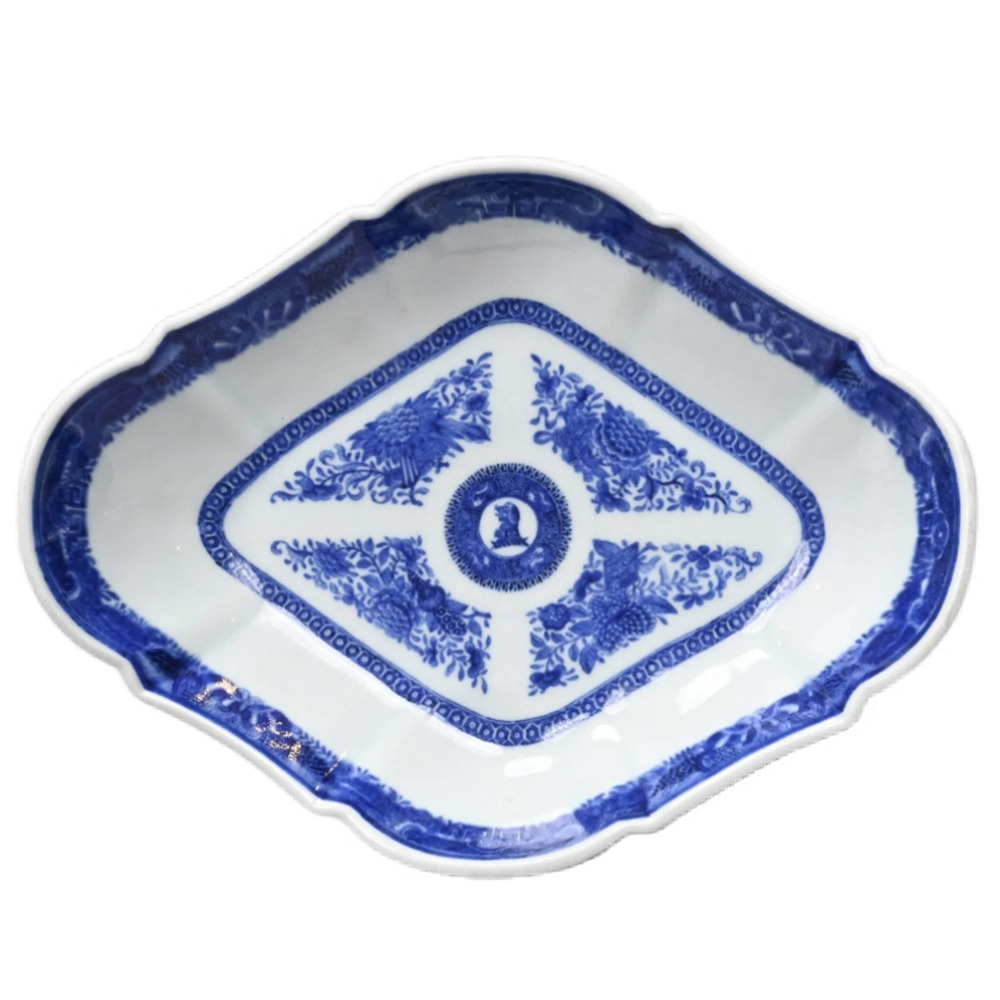
This exquisite pair of Chinese Export porcelain compotes is a superb example of the beloved blue Fitzhugh pattern, customized for the Western market. Each piece bears a prominent family crest, historically attributed to either the Alexander or Kiddell families.
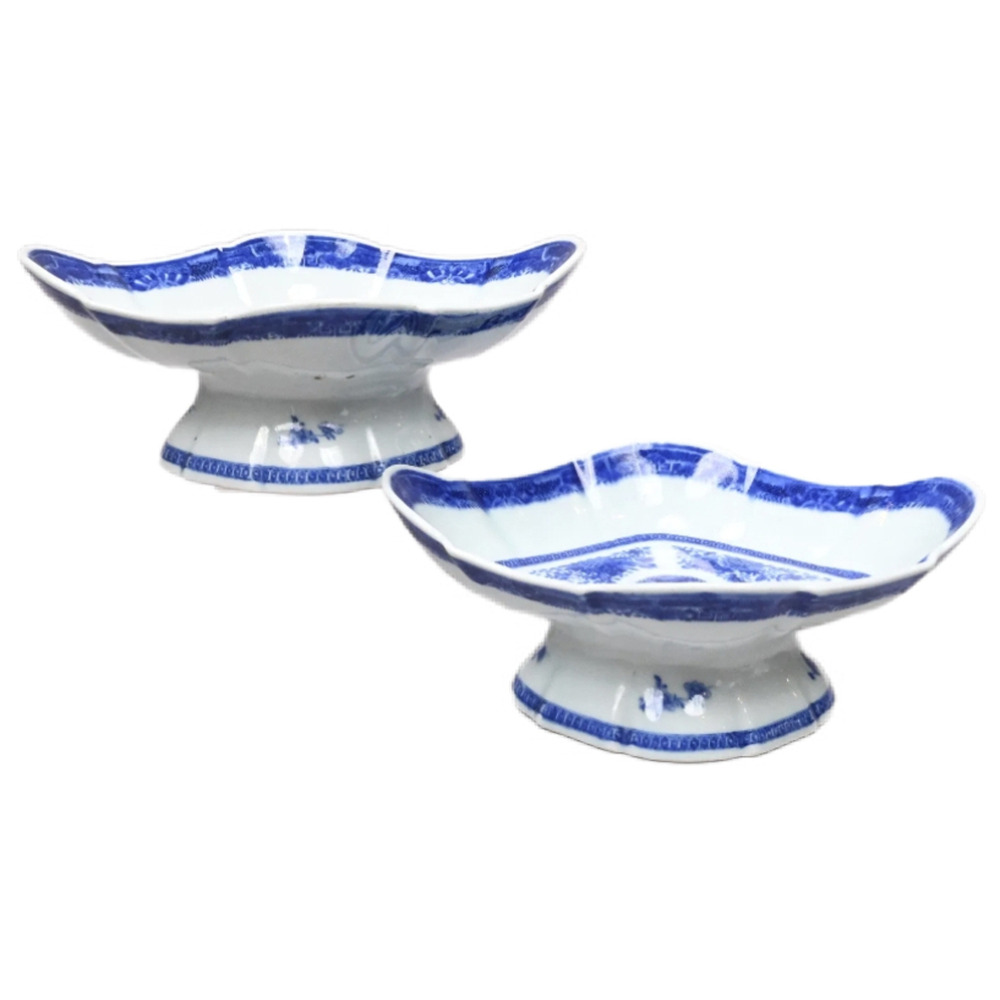
The compotes feature an elegant, diamond-like lozenge form. The central interior is beautifully decorated with the family crest enclosed within a classic roundel, which is flanked by four traditional clusters of flowers, fruit, and scholar's objects. This central imagery is framed by a highly detailed, cell-patterned border along the rim. The exterior foot of each compote is further decorated with delicate floral sprigs resting just above a matching cell-patterned band.
Measurements:
Height: 5 inches (12.7 cm)
Width: 12 inches (30.5 cm)
Depth: 9 inches (22.9 cm)
Literature
For an authoritative reference on this specific crest and pattern, collectors can refer to David Sanctuary Howard's definitive text, Chinese Armorial Porcelain, Volume II, page 540.
The Heraldic Mystery: Crest vs. Coat of Arms
The reason for the ambiguous attribution comes down to the specific artwork ordered for the center of the compote. Because the family chose to only have their crest painted (the smaller, secondary emblem that traditionally sits on top of a knight's helmet) rather than their full coat of arms (the large shield), it creates a historical blind spot.
While full coats of arms are entirely unique to a specific person or branch of a family, crests were frequently shared by multiple, completely unrelated families. Both the Alexander and Kiddell families officially registered identical (or nearly identical) crests with the College of Arms in England. Without the unique shield or a family motto painted beneath it, even top experts like Howard have to leave the attribution open to both!
The China Trade Connection (Circa 1805)
During the early 19th century, commissioning a custom Chinese Export service of this magnitude was incredibly expensive and almost always required a direct connection to the East India Company (EIC) or the maritime trade.
The Alexanders: The Alexander family had deep, highly profitable ties to the East India Company during this exact period. Several prominent Alexanders served as "supercargoes" (the company representatives who actually lived in Canton and managed the purchasing of tea, silk, and porcelain) as well as ship captains. An Alexander family member stationed in Canton would have had direct, VIP access to the Jingdezhen porcelain agents, making it very easy (and much cheaper) for them to order a customized blue Fitzhugh service to ship back home to Britain.
The Kiddells: The Kiddell family—an old English family with early roots in Yorkshire—also had members heavily involved in the mercantile, banking, and shipping trades who could have easily brokered such a luxury commission.
Because the Fitzhugh pattern (named after Thomas Fitzhugh, an 18th-century director of the East India Company) was the absolute height of fashion for mercantile families in 1805, either family makes for a perfect historical candidate.
Vandekar website link:
https://vandekar.com/inventory/Ceramics/Asian%20including%20Chinese%20&%20Chinese%20Export/18th%20Century/works/28563
(Ref: NY11081-apux)
| Dealer | Earle D. Vandekar of Knightsbridge, Inc. |
| Date: | 1790-1800 |
| Origin | China |
| Artist/Maker | Chinese Export |
| Measurements | Height: 5 inches (12.7 cm) Width: 12 inches (30.5 cm) |
| Inventory | View Dealer's Inventory |
| Website | http://vandekar.com |
| Price | $3,000.00 |
| Contact | Paul Vandekar, 212-308-2022 or info@vandekar.com |

© Antiques Dealers' Association of America P.O. Box 218, Northwood, NH 03261 · 603-942-6498 · Privacy Policy · Dealer Login

